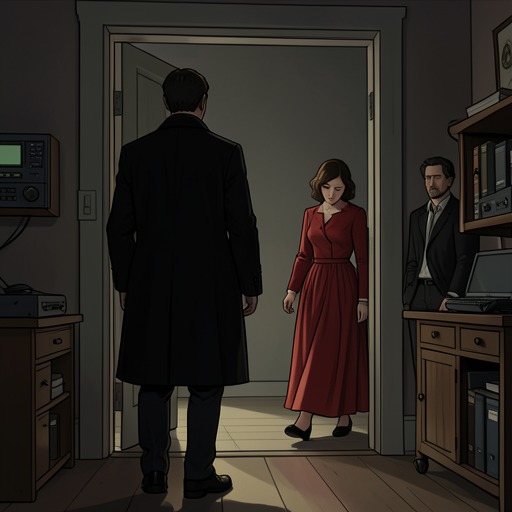
Reinhold runs over Franz Biberkopf
Berlin AlexanderplatzReinhold runs over Franz Biberkopf in a deliberate attack that leaves Franz without his right arm, a lasting bodily consequence that reshapes his life without ending his attachment to his assailant. The novel discloses the assault retrospectively: Franz names Reinhold as responsible, while later testimony and recollection expose the strange distance between the injury’s severity and Franz’s refusal to condemn him.
Disclosure and Circumstances
At four in the afternoon, Franz returns to Eva and Herbert and speaks at length for the first time. He has read in the newspaper that Karl the tinsmith informed on the gang, and connects Karl with the events in Freienwalde, where Mieze was taken. Franz says Reinhold threw him under a car and ran over his arm. He interprets the attack as an effort to crush him, but says Reinhold realized he had not broken him; Franz then links that failure to Reinhold’s taking Mieze from him. His account makes the assault part of a wider sequence of betrayal and violence, while leaving some details uncertain: Franz speculates about how Mieze was transported and when she may have been killed rather than claiming to know precisely.
Injury and Franz’s Response
The physical consequence of the attack is lasting. Later, Franz usually does not wear his artificial arm, but goes out with it on, keeping the false hand in his coat pocket and holding a cigar in his left hand. The changed body is thus presented through an ordinary act of going out, rather than as a condition that disappears once the assault is over.
In a later confrontation, Death recalls that Franz did not collapse when Reinhold put him under the car and drove over his arm. Under the wheels, Franz resolved to be strong. The contrast matters: the attack causes a profound bodily loss, but Franz’s immediate answer is not reflection on the people or circumstances around him. Death’s rebuke is that he fails to look properly at others or ask why events have happened. The assault therefore becomes both a physical turning point and an occasion for questioning the narrow, self-directed strength with which Franz initially meets disaster.
Mieze and Reinhold
Franz’s account connects the attack to Reinhold’s later treatment of Mieze, but it presents Franz’s understanding of Reinhold’s motives, not an independently confirmed explanation of every step. Franz believes Reinhold took Mieze after realizing he had failed to crush Franz. The two acts become joined in Franz’s telling: his survival does not end Reinhold’s violence, but is followed by the loss of the woman he loves.
The relationship between the two men remains deeply contradictory. At Reinhold’s trial, Franz testifies that he and Reinhold had been good friends and describes Reinhold as having a terrible, unnatural compulsion involving women. He suspects Mieze resisted Reinhold in Freienwalde, but says he does not know whether Reinhold had sadistic tendencies. His testimony offers a judgment about Reinhold’s conduct while stopping short of certainty about his inner nature.
Trial and Aftermath
At the trial, Franz gives evidence as a one-armed man whom the experts consider recovered and fit to be cross-examined. He is not indicted. Though he speaks about Reinhold and Mieze, he will say nothing further about Reinhold, his arm, their quarrel, or their fight. The omissions keep the assault from becoming a complete or settled account of their bond.
Franz and Reinhold stare at one another in court. Franz feels no pity for Reinhold in the dock, but retains a strange affection for him, looking at him steadily and imagining that he could meet him again without becoming hard-hearted. That response gives the attack an unresolved ending: Reinhold’s violence has permanently altered Franz’s body, yet it has not severed Franz’s emotional connection to him.